
From Sunlight to Smart Lamps: What to Consider When Planning Home Lighting
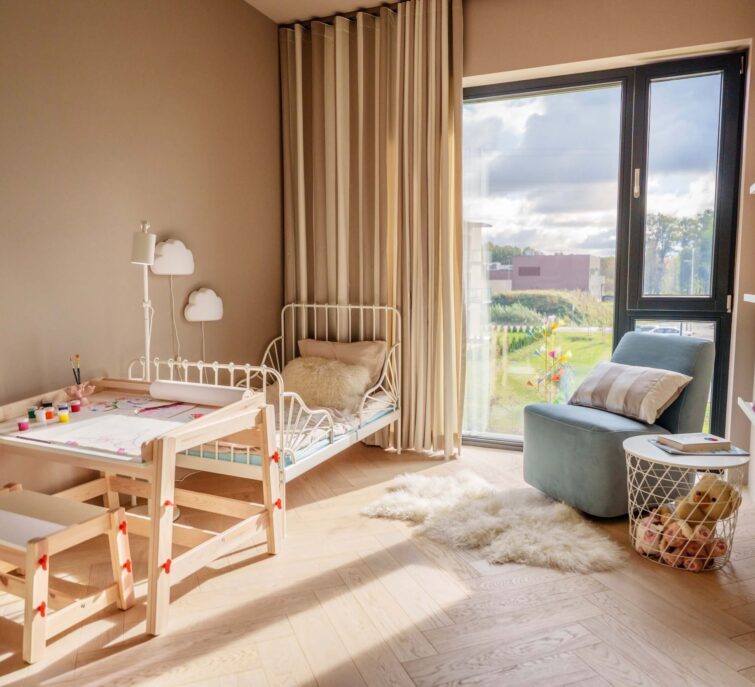
Light is one of the key factors that influences how comfortable a space is to use, as well as the well-being, mood and even health of the people in it – often more than we might think. When planning a new home, it is better to have slightly more light sources than too few.
Entire books could be written about home lighting, but we hope the brief suggestions below will also provide inspiration and help when making decisions.
Make the most of natural light
The best light enters through the windows and should play an important role in the design of your home. When planning rooms and arranging furniture, pay attention to where daylight enters the room most and think about how to make the best use of it. For example, both a desk and a dining table are best placed closer to a window.
Analyse the role of lighting
Before planning lighting solutions, think about how lighting will be used in each room. In the kitchen, for example, functional lighting is essential, but there should also be an option for cozy ambient light. In the living room, it should be possible to create a warm and comfortable atmosphere. Depending on the brightness of the lighting, it becomes easier to concentrate or relax.
Create options to adjust the lighting
When planning general lighting for each room (such as a track light or a central ceiling lamp), consider whether it should be dimmable. In addition to general lighting, think about other types of lighting that provide directional or accent light. In the living room, general lighting is very helpful when cleaning or putting together a 1,000-piece puzzle. For a Netflix evening, however, you might want to create a cozy atmosphere with accent lighting – whether it is a recessed LED profile or an adjustable wall light.
A cozy atmosphere can also be created with dimmable pendant lights, floor lamps, table lamps and TV backlighting. Light sources that create a warm mood should illuminate a surface such as a wall, table or worktop, leaving the rest of the room softly dimmed.
Plan kitchen lighting with dark winters in mind
When planning kitchen lighting, think about your habits and needs. The light above the worktop should be good and practical. Even on dark winter evenings you want to clearly see what goes into the pot. Why not also use the LED strip above the worktop as mood lighting when the rest of the room is dimmer? In this case, it is best if the light is dimmable, recessed under the kitchen cabinets toward the outer edge, and the cabinet doors extend slightly lower than the light fixture. This prevents the light from shining directly into your eyes when sitting at the dining table or on the sofa. The dining table lamp should also be placed at a height where it mainly illuminates the table and does not shine directly into the eyes of those seated.
Pay attention to lighting in the children’s room as well
Unfortunately, lighting in children’s rooms often receives the least attention from both developers and homeowners. The images below show some examples of how lighting fixtures in a children’s room can be arranged in harmony with furniture. Such a lighting solution makes it possible to adjust the functions of lighting throughout the day and as the child grows. Of course, the solution can be much more detailed by adding wall lights, integrated furniture lighting and suspended ceiling lighting. The examples shown do not yet require detailed furniture drawings.
We recommend adding a permanent power connection in the wardrobe location so that interior wardrobe lighting can be installed if needed. Next to the bed, it is worth planning a place for a wall light – a night lamp for younger children and a reading lamp for older ones. Track lighting allows the light direction to be adjusted, additional fixtures to be installed and the switching scheme to be changed in the future.
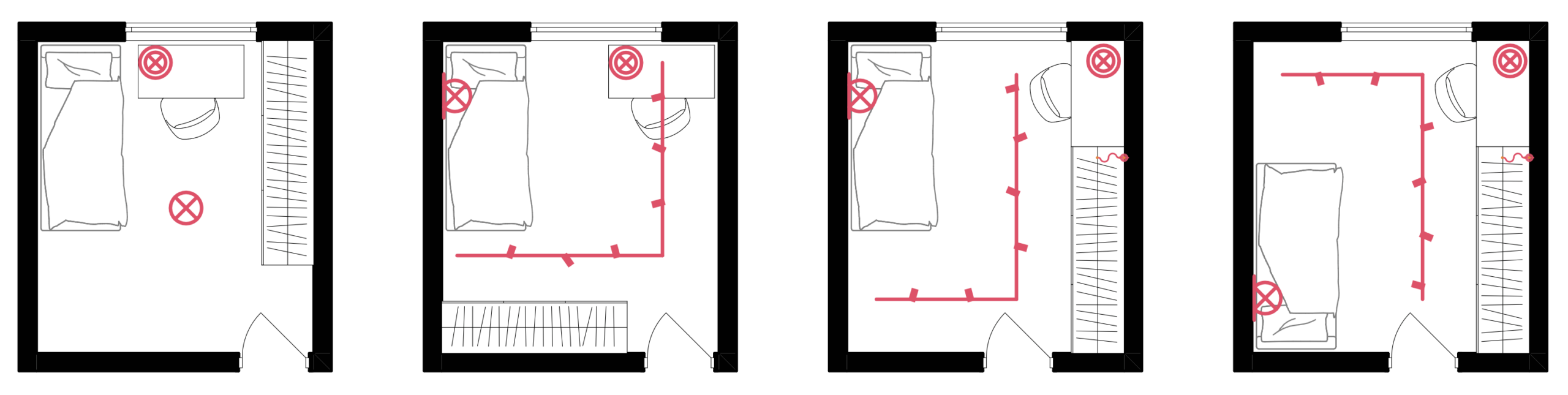
- First room from the left
A typical lighting solution for children’s rooms. One lamp in the middle of the room is a safe choice, but it does not offer many lighting possibilities.
- Second room from the left
A wall light and an adjustable track light have been added to the ceiling.
- Third room from the left
An extra cable connection has been added to the wardrobe, making it possible to illuminate the wardrobe from inside or from the outside.
- Fourth room from the left
The layout has been changed so that a naturally lit play area appears in front of the window.
Plan lighting solutions early
When creating a home, the lighting planning stage allows you to design recessed lighting solutions and route power cables exactly where you want them. It is wise to install power cables not only for kitchen furniture but also behind larger furniture items such as wall cabinets, bookshelves, utility room cabinets, mirrors and more. Even if you do not yet know all the solutions during the planning stage, it is possible to leave extra cable for future use.
Save energy and consider additional convenience
Modern homes mainly use LED lighting, but even that should be used wisely. LED bulbs are energy-efficient and long-lasting. It is also worth considering motion and/or presence sensors to avoid unnecessary energy consumption when no one is in the room. Smart placement of sensors also increases convenience. For example, in a guest bathroom there is no need to search for a light switch if a sensor turns the light on automatically. During the planning phase it is also possible to add a master switch that turns off all lights at once, so you do not need to check every room before leaving home.
Use flexible solutions
Often homebuyers do not yet know all their future wishes or needs. Instead of planning four or five different lighting solutions in every room just in case, you can choose more flexible options such as:
- dimmable lighting, which allows you to adjust brightness using special switches,
- track lighting – the track location should be planned during the home design stage,
- fixtures that can be moved along the track whenever needed.
When using dimmable lighting, make sure the selected light bulb is dimmable, as the switch alone cannot perform this function.
What if the planning stage is already over and all lights are installed? Products from Philips Hue and IKEA Home Smart are a good way to upgrade your home lighting. Among other options, these systems offer smart bulbs with the common E27 and GU10 sockets, which can be used in existing light fixtures. Products from both ranges can be controlled with a smart device. In addition to switching lights on and off, you can adjust brightness and colour temperature.
Explore homes created by Liven here.